
Benefits all types of Lead-Acid Battery (Flooded, AGM, GEL, Sealed, VRLA, Etc.)
| Desulfater.com > Description |
|
Description, Theory of Operation,
and Advantages
Related: Full Technical
Specifications
- Introducing the new 12V1000 Series
- Theory of Operation
- General Advantages
- Financial Savings
- Environmental Benefits
 Introducing
the new 12V1000 Series
Introducing
the new 12V1000 Series
Our popular electronic desulfater model PULSER-VI MK2 is now available in a new and improved design, and has been renamed 12V1000 Series. Based on our wide experience with the previous generation model, this new version includes added features and several key refinements on the operating parameters. Bellow you will find a list of these technical improvements. Also available is the relevant information about the Operating Principles of our electronic battery desulfater.
Technical Improvements of the 12V1000 series
Bellow is a brief list of the technical improvements that have been incorporated into the design of the new 12V1000-AT and 12V1000-M models.
- Improved efficiency of the pulse generating circuit, with higher output capacity, at reduced current consumption from the battery (on average only 65 milli-Amps). The new improved circuit has the capability of generating instantaneous very short duration pulses of up to 50 Amps, depending on the internal resistance of the battery under treatment.
- The 12V1000-AT Electronic Battery Desulfater model incorporates a newly redesigned higher precision battery voltage monitoring circuit that will automatically shut off the device in a situation where the battery reaches a low voltage of 12.1V. This will prevent any damage due to a very deep discharge, for example in cases of a battery that is not being monitored on a regular basis, and might not be recharged immediately. Also, the desulfater will not turn itself back on until that same battery voltage has once again reached a safe level of at least 12.5V.
- During manufacture we only use electronic components of proven reliability and high quality. All resistors that set critical operating parameters are metal-film, commercial grade surface mounted devices (SMD) and have 1% or better error margin. All capacitors are rated to 105 degrees C, and with operating voltages with an ample margin of safety. Only ferrite inductors of the highest proven efficiency for the working parameters are used. The circuit board is manufactured in FR4 fiberglass material, and has to pass stringent quality controls (IPC-A-6011/6012 and IPC-A-600 Class 2).
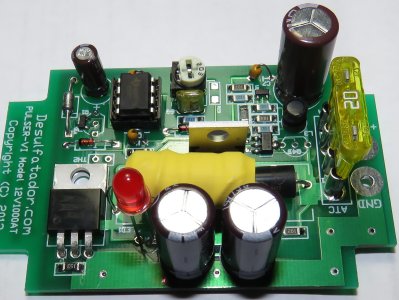
- Integrated electronic over-voltage protection up to 16V, plus internal fuse to protect wiring and battery in case of a reverse polarity connection, or short circuit.
|
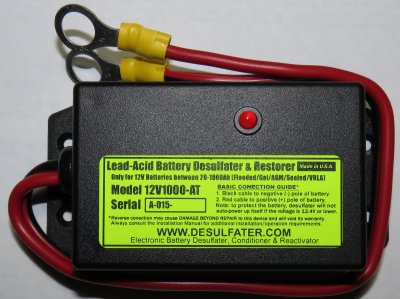
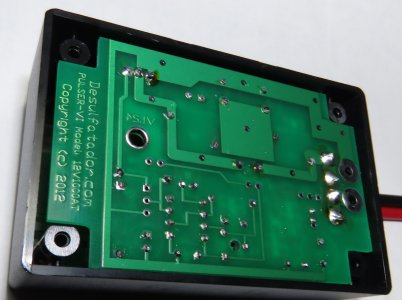
Pictures of the new 12V1000 Series electronic desulfater.
|
||||||||

Additional Models Available Soon
We are currently researching and developing Electronic Battery Desulfater models that are capable of operating at higher individual battery voltages (24,36 and 48V). Also, we plan to release models that are capable of servicing batteries and battery banks of higher current capacity (3500-4000Ah). If you might be interested in these future releases of our Electronic Battery Desulfater, we invite you to subscribe to out eNewsletter so we can keep you current to any developments. If your immediate needs are closely related to the products mentioned above, please drop us a note as we would like to keep you in mind for any future product developments.
The Electronic Battery Desulfater connects directly to the terminals of the battery and permanently benefits it by injecting high-frequency pulses that regenerate and prevent sulfate buildup on the plates. It will automatically shut itself off when it detects that the battery voltage has reached or is bellow 12.1V in order to prevent a damaging deep discharge. It has a red LED indicator that will light up to indicate that it is operating correctly, and is very efficient as it only requires on average about 65 milli-Amps (0.065Amps) to operate. It only requires such a low amount of current, as the pulse generating circuit operates in a very similar fashion to a spring board, that allows an athlete to jump much higher that normal, with very little energy.
The internal circuits of our Electronic Battery Desulfater contain a frequency controlled oscillator that drives a pulsed voltage generating section that in term provides the pulses to the battery that help promote sulfate shedding on its cell plates. These pulses, depending mainly on the internal resistance of the battery, its temperature, and other factors, can reach a level of 35V or more, but its duration is extremely short, and last only a couple of fractions of a second. One of these pulses can be seen in the following images that where taken during a test with the use of a high-speed oscilloscope. For this test, a n Tektronix 2247A 100MHz oscilloscope, and a freshly recharged 12V 45Ah battery was used, so its reflected voltage is still in the 13.7~13.8V range. Bellow each image you will find a technical explanation of its meaning.
The high energy pulses that can be seen bellow, is what causes sparking on the terminals of the Electronic Battery Desulfater when it is initially connected to the battery, even though the continuos current consumption is a mere 65mA. These are the pulses that remove the sulfate from the battery cell plates and help to keep the clean, and in optimal condition!
 |
|
PICTURE 1: This AC coupled measurement shows a pulse with an amplitude of 12.6V. This measurement would appear to be related to the battery voltage itself, but in reality it is the pulse voltage above the battery voltage. This measurement is obtained by selecting AC coupling at the input of the oscilloscope, which will block any DC voltage from the battery, and will only allow the pulse itself to be measured. This can be confirmed by the "~" AC symbol next to the measured voltage. |
 |
|
PICTURE 2: This DC coupled measurement shows the same pulse as above, but the amplitude shown now is 25.98V, which is equal to the sum of the pulse amplitude plus the battery voltage. This measurement is obtained by selecting DC coupling at the input of the scope, which will allow both the pulse and the battery DC voltage to be measured and summed. |
 |
| PICTURE 3: This AC coupled measurement is taken across a 0.1-ohm resistor connected in series with one of the power cables of the Electronic Battery Desulfater. In essence this allows the measurement of the instantaneous current flow of the pulse. Since the pulse being displayed shows an amplitude of 2.87V, this means that the net pulsed current flow into the battery cell plates is 28.7Amps (ohms law states that voltage divided between resistance equals current, so 2.87V / 0.1-ohm = 28.7A. Again, it is this very short duration high frequency current pulse that helps dislodge sulfate from the battery plates and keep them clean. |
- Can duplicate (or even triple) the expected battery life.
- Restores the capacity of many old or discarded batteries.
- Improves performance and battery efficiency.
- Shortens the charging cycle.
- Extends working time between charges.
- Stops and prevents premature cell damage due to sulfation.
- Reduce battery changes during operative life of machinery or equipment.
- Extends service life and reduces damage to electrical components of vehicles and machinery.
- Reduces consumption and need for replacement of water in the cells.
Financial
Savings (Applicable to both small and large scale business)
- Reduction of battery replacement costs.
- Improved efficiency and productivity of machinery and equipment due to reduced down time.
- Up to 50% reduction of battery charging costs.
- More flexible, efficient, and productive battery management.
- Lower cost equipment and machinery maintenance programs.
- Helps avoid unnecessary waste and pollution.
- Drastic reduction of lead and sulfuric acid emissions into the environment.
- Helps avoid possible environmental fines.
- Improves the environmental image of your business.
Notes: